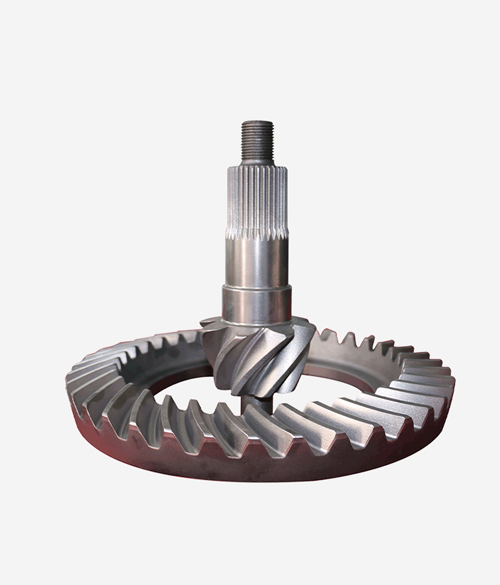
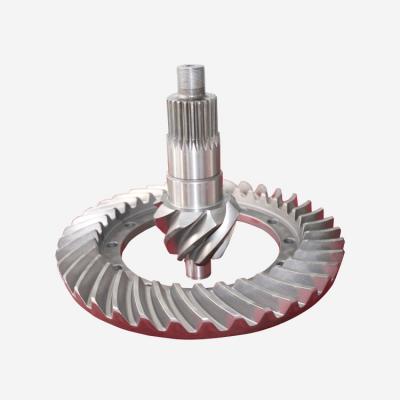
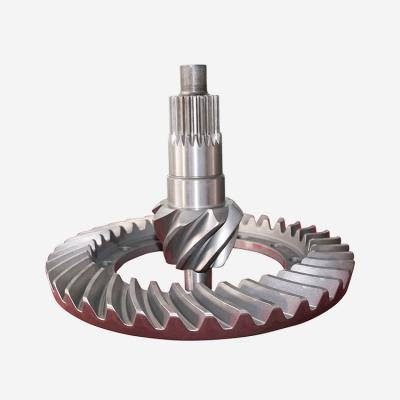
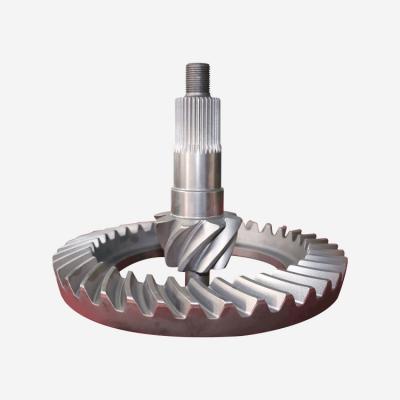
The main core component of the main reducer assembly - the driving and driven bevel gear
In modern automobile drive axles, spiral bevel gears and hypoid gears are widely used in the final drive assembly. In the double-stage final reducer, a pair of cylindrical gears (mainly helical cylindrical gears) or a set of planetary gears are usually added. In the wheel final reducer assembly, helical cylindrical gear transmission or planetary gear transmission with ordinary parallel shaft arrangement is usually used. Worm gear drives are sometimes used in the final drive assembly of some buses, trolleybuses and super heavy vehicles.
The main and driven gear shafts of the spiral bevel gear cross slightly, and the intersection angle can be arbitrary, but on most automobile drive axles, the main reduction gear pair is arranged at an intersection angle of 90°.
In the final reducer assembly, due to the influence of the overlap of the gear tooth end faces, at least two or more pairs of gear teeth mesh at the same time, so the spiral bevel gear can bear a large load. In addition, the gear teeth do not engage the entire length of the tooth at the same time, and the surface gradually turns from one end of the tooth to the other end continuously and smoothly, making it work smoothly, with little noise and vibration even in high-speed operation.
The hypoid gear is shown in the figure, the axes of the driven gear do not intersect, and the space intersects. Its spatial intersection angle is also 90°.
Compared with the driven gear shaft, the driving gear shaft has an upward or downward offset, called up or down offset. This offset is called the offset distance of the hypoid gear. When the offset distance is large enough, one gear shaft can pass through the other gear shaft. In this way, compact brackets can be arranged on both sides of each gear. This is beneficial to improve support stiffness, ensure correct gear meshing, and improve gear life.
The offset distance of the hypoid gear makes the helix angle of the driving gear larger than that of the driven gear. Therefore, although the normal modulus or the normal pitch of the hypoid transmission gear pair is equal, the end modulus or the pitch of the end face is different. If the end face modulus or end face circumferential pitch of the driving gear is larger than that of the driven gear, the diameter and strength and rigidity of the driving gear of the hypoid gear are greater than that of the corresponding spiral bevel gear.
Its increase is related to the size of the offset distance. In addition, due to the larger diameter and helix angle of the driving gear of the hyperboloid transmission, the equivalent curvature radius of the meshing gear is larger than that of the corresponding spiral bevel gear, thereby reducing the contact stress between the tooth surfaces. Compared with a spiral bevel gear with the same contact stress, the load of the hypoid gear can be increased by up to 175%.
If the helix angle of the hypoid drive gear is large, the minimum number of teeth for undercutting can be reduced, so fewer teeth can be selected, which is beneficial to transmission with a large transmission ratio. Hypoid gears make more sense when large transmission ratios and limited profile dimensions are required. Because if the diameter of the driving gear of the two transmissions is the same, the diameter of the hyperboloid driven gear is smaller than that of the spiral bevel gear, which is the main reduction ratio i≥4.5. The transmission has its advantages. When the transmission ratio is less than 2, the hyperboloid driving gear is too large than the spiral bevel driving gear. At this time, it is more reasonable to choose the spiral bevel gear, because the latter has a larger space available for the differential.
Due to the increase of the helix angle of the hypoid driving gear, the average number of teeth entering the mesh is larger than that of the helical bevel gear. Therefore, the transmission of hypoid gears is more stable, noiseless and stronger than spiral bevel gears.
The offset distance of the hypoid gear also brings convenience to the overall layout of the car. For example, when the main reducer adopts lower bias (the driving gear is left-handed), the height of the car's drive shaft can be lowered, thereby reducing the height of the car's floor or setting the height of the floor protrusion caused by the drive shaft channel, thereby reducing the appearance of the car.